Sometimes you just see a book synopsis and a recommendation and you just want to take the plunge. I'm often struck by the notion that some books find you at the right time, and one's own mood, needs and desires affect one's enjoyments of books and other media more than we care to admit. I think 'Upon A Starlit Tide' found me at the right time. A time when I need just a little bit of magic, a little bit of wonder, the heart tugging emotions of romance and falling in love, a little bit of familiarity in an uncertain landscape. This book has given me what I need.
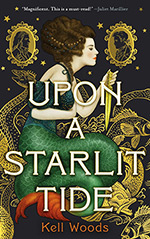
'Upon A Starlit Tide' is described as a fairy tale retelling of 'Cinderella' and 'The Little Mermaid' set in 17th Century Brittany in the port city of Saint-Malo looking out over La Manche (the English Channel for British readers). Saint-Malo is a walled city which is a centre of trade and a hub of privateers (largely legalised piracy against state enemies). The tensions and war with England across the channel provides an underpinning tension throughout the novel. Our protagonist is Lucinde Leon, the youngest daughter of the rich sea-faring Leon family (with of course two older sisters) who early in the novel rescues a handsome wealthy son of another Saint-Malo family, Morgan de Chatelaine out of the water following a shipwreck. The novel broadly develops into a love triangle with the rugged English smuggler Samuel, Luce discovers who she is and what she wants out of her life.
Before I head to far into the review, I should share that whilst I won't give away any major spoilers if one has read the blurb for the book and seen the cover you probably will work out what some of the big spoilers in the book are.
So what are some of the things that I liked? I loved the weaving of Brittany folklore and fae creatures into the setting. There are jetins that throw stones at people loitering on their shore, there are fairies in the flowerbeds, there is a sea-witch who rides her little black boat on the water who everyone gives a wide berth and of course every sailor has a story about the time they saw a sea maid and she either gave them good fortune or caused their ruin. This folklore interweaves with sailor superstitions and rather than being flavour to the overall story instead it becomes an important part of the story and the character's actions.
I also really liked the setting of Saint-Malo. You can tell the author has been there and immersed themselves in the environment. The architecture and the dockyard feel very real. There is a teaser in the book about a character seeing what happens to Saint-Malo and I found myself spotting the misdirection, having a good guess at what was inferred and researching if it really happened. If one is reading a story of magic and the fae influencing the real world there has to be enough hooks to ground it in reality and I think Kell Woods does a great job.
I also think, for those who wish to imagine grand masked balls with exquisite food, dances with beautiful women in elaborate gowns and dashing, charming men there is plenty of that here. It seems a little silly to say it, because my 'real life' views wishes to push back against these highly stylised, sanitised images of heavily made-up beautiful young women in gowns but I would be lying if I said these tropes didn't make my heart flutter a minute. Maybe it's because I never had a prom, (and never would have gone anyway). In short, if this rocks your boat, you'll love it, and if it is the kind of imagery that turns your stomach, well it will. But for now, I'll delight in whispering secret adorations to a heart's desire...
I also think Kell Woods writes very well. The style is easy on the reader, it's simple and isn't especially demanding. That could sound like a knock but it really isn't. There is a spaciousness in her words that lets you go along at an easy pace until you really need to speed up. The reader isn't treated like an idiot, there are obvious cues to deeper themes and ideas to explore but for a book ostensibly concerned with water it's not deep, but neither is it shallow - you can go as deep as you go. The descriptions are evocative, without being overwrought and at times there is a turn of phrase that reminds you that you are in a fairy tale, as it feels imbued with emotion, or just captivates your senses or your heart. I always had a sense that I was consciously enjoying my reading experience.
If I had some criticisms of the plot, it may be that some of the book is a little bit too much on the nose. The 'Cinderella' influences whilst important to the plot somewhat feel a little shoehorned in. Some of the mechanics to put characters wherever they need to be to make the next thing happen at times feel a little clunky, a little contrived. That's not to say things feel forced, but there are times when I thought, 'if this incredible stroke of coincidence or fortune doesn't occur the whole novel falls apart'. I guess it happens in every novel, but for me it was noticing it that was a little jarring.
I have somewhat mixed reviews of the characterisation. There is a love triangle but the reader quickly realises that Samuel as the rugged rough smuggler is THE ONE. He seems a little too perfect at times (good family man, caring, good friend, mindful of Luce's status, rugged sailor six pack). Morgan, although initially presented as being worth 1,000,000 SWOON points is clearly presented as a rake, selfish, incompetent and cruel. This ties in with how I feel about Luce and her sisters. It's not particularly clear how old she is but I am guessing we're meant to think of her as late teens and her sisters not too much older than her (as they are still trying to get wed). In the early part of the novel I want to scream at her for being really stupid and not seeing the obvious in front of her. That could really annoy some, but in some ways I felt like how I would feel if any of my children tried to date a complete jerk and they weren't listening to me. Upon reflection it works. She grows significantly as a character, and as she learns who she is, and what she wants she grows in power. Ultimately she discovers she is a woman with her own agency. When she finally discovers this it is amazing. I found throughout the book that I wanted Luce to be happy and I cared about her and what happened. That's a big plus in my book. I also wanted Morgan to be kicked to death and couldn't care less about the rest. I suppose Luce's sisters show a little character development but they are a little one dimensional too, along with Samuel.
I was thinking reading the book to what extent a feminist lens could be applied to the book. In the early part of the book I was thinking no, because there seemed a little bit of finding the fairy tale husband, getting to wear nice dresses and being married off. Of course that's the 'Cinderella' story and to be fair that's dropped midway through the book, as though Luce finds a new purpose. I was also thinking that the romance was a little archetypal in terms of the poor lover and the bounder. What changed my mind was thinking about how Luce transcends what is expected of her. Yes, the novel is pitched as her needing love, but it's also about recognising her sexual desires and passions. (As an aside I think the romance, sexual content and post-sex content is done really well. It's sensuous, and evocative without being explicit. It's adult and mature without needing to hide behind moral sensibilities.) She finds what she desires most of all is her freedom and agency. This novel is ultimately about women breaking out of patriarchal confinement - about what a woman should wear, do, think, say. The novel carries on telling Luce not to dream. Samuel says, 'do you know what would happen to you on ship'. A reminder that the threat of male violence is everywhere where men are. Luce sends a big 'FUCK YOU' to patriarchy in the book when she finds herself and it is utterly glorious when it happens. I also loved how she made her choices that put herself first, further subverting the tropes of the fairy tale. (The last couple of chapters of the book are great and even as the tropes are subverted, there is still plenty to tug on your heart strings. I nearly cried...).
I love La Manche as a character in itself. The sea is presented as capricious, a giver of fortune and sustenance but always a threat to life. In some ways, the sea-maid is the fae archetype of the sea, and through a patriarchal lens I couldn't help read this as 'the man, sees women through his eyes in terms of what she does to him, through seduction, gifts of home, fortune and family. His biggest fear is that she has power of her own to change that'. The mermaid is beautiful, desirable but she is the woman a man cannot control and that is what he fears the most.
Really glad I read this. It's a light read, a bit obvious in places. The tropes are bended rather than broken but that leads to a cosy familiarity underpinning the tensions in the novel.
Recommended.
 bazhsw
