 bazhsw
12/15/2025

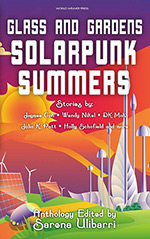
I definitely like the idea of this book and the ethos behind it perhaps more than I enjoyed reading it. This anthology of solarpunk short stories is a bit of a mixed bag with the quality ranging from 'meh' to 'decent' with nothing really 'wowing' me. Solarpunk is a genre which in some ways is quite hard to define because it's focus is on future harmonious relationships between humans and planet, which means it can run the risk of being too utopic, or be dismissed as ecological evangelising. I'm quite new to the genre, but it is something which I am considering exploring more as part of a reading challenge. What I think I find is that solarpunk is at it's best when it shows us a better way of living and still presents us with the conflicts that this world presents. I think about this in terms of my own relationship to anarchism and how just because it promotes the absence of hierarchy and I believe will be a better way to live, it does not mean that all problems and challenges disappear - it just means we have to work them out differently.
And I guess this is where the best stories in this collection come in - where they show us better, but there are still ethical considerations to resolve. For instance in 'Watch Out! Red Crusher!' by Shel Graves humans know display their mood and personality via their skin colour - in effect the 'aura' or 'mood' we have is clearly visible and if someone is Red then they are angry or disposed to violence. On one level this gives a community a sense of safety against violent predators and they choose to banish those who can't live harmoniously with others. A future where people can protect themselves against those who would harm doesn't sound so controversial right? Except one can't help but read this as a justification for racism, and casting out those who clearly look different with a justification of 'that's the way they are'. It's also an exploration of children's mental health, dealing with anger and depression and asks even those who would consider ourselves good people to try harder, to work with those who suffer rather than put them on a scrapheap.
Not every story has a deeper ethical question. 'A Midsummer Night's Heist' is essentially a beautiful, creative, imagining of revolutionary direct action against fascism. In many respects it's one of those stories where everything feels like it falls into place just so, and that normally annoys me but I have to say I was punching the air at these beautiful activists creating a living garden and autonomous space against fascists.
I really enjoyed 'Camping with City Boy' which is almost like a coming of age story where two couples white water raft. One of the boys is a popular, rich kid pretty boy and his partner feels in his shadow. As she rafts the rivers in a stunningly beautiful Canada she realises that her boyfriend is a vacuous spoilt brat and a baby man and she would be infinitely better without him. I loved her journey as she realises her own worth, strength, and that she deserves far better than the men others fawn over.
The anthology ends with a really sweet love story called 'Under the Northern Lights' which whilst not particularly deep and with quite an uninteresting narrator, I nevertheless let my heart swoon for people finding people.
There are some really good ideas in here - about food production, about the relationships between nature and machine, about choosing to live off-grid, what family and community is, and of course who defines what 'better' is.
Definitely worth a look.