 bazhsw
8/24/2026

May be minor spoilers in the review
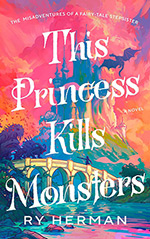
'This Princess Kills Monsters' is a mostly delightful cosy and rather funny riff on fairy tale retellings that has an awful lot of heart and playful irony but somewhat struggles to hit it's big picture themes in ways which are satisfying.
I'll preface my review by saying that for maybe the first two thirds of the book I felt I was having a thoroughly good time with this book. I was smiling, I was in on the joke and the book felt like putting on a comfortable pair of slippers. The book equivalent of light entertainment that hits the spot perfectly. There is a phrase that is stuck in my head somewhat, and that is that 'the plot got in the way of telling a good story'. By that, what I think I mean is, that the story telling devices, of stories within stories, the setting and the characters all having a lot of fun with what happens in a fairy tale world is mostly excellent. I slipped into the world really easily. Where it struggles a little is when an overarching plot and resolution is wrapped around the setting and it just doesn't hang together quite so well as it could.
'This Princess Kills Monsters' is a retelling of 'The Twelve Huntsmen' fairy tale where to cut a short story even shorter, a woman is betrothed to a prince, he breaks off the engagement and is getting married to a princess from a faraway land. The woman, finds eleven identical people, they present themselves as male hunters, defend the now King who has a talking lion convinced the hunters are women and through a bunch of personal sacrifice and true love and all that the King realises he loves his original love.
The author in the first chapter introduces this story, and through the perspective of Melilot, the aforementioned princess from a faraway land she summarises the original fairy tale, then tells us that's not what happened. Through Melilot and other characters there is often a pause where some back story is told, often very familiar to a well known fairy tale and utilising similar structures. It's all very charming, and ranges from little smiles in the reader to being really funny at others. There is a casual conversational nature to the text where light sarcasm is dripping but it never feels mean. It's almost as though through the thoughts of a young woman (I'm guessing Melilot is around 20) we feel her eye rolling, but I never feel that Herman is being disrespectful or dismissive of the source material. It's more of a laugh at the tropes - especially the more patriarchal ones.
Recognisable fairy tales are weaved through the book, as well as 'The Twelve Huntsmen', there is plenty of 'Sleeping Beauty', 'Snow White and the Seven Dwarfs', and 'Rapunzel' in the main plot. There are also nods to 'Goldilocks', 'Red Riding Hood', 'Cinderella', 'The Magic Porridge Pot', 'Jack and the Beanstalk', 'The Brave Little Tailor' and 'Beauty and the Beast' and probably a fair few others. What this means is, that this is a world which is fantastical, where magic and the impossible can 'just happen' and we can just go along for the ride. It's all quite a good laugh and a bit of fun really. Whilst reading the book, I wanted to go back and re-read all those stories that gave me joy as a child.
I also appreciate the LGBTQIA+ representation in the book. The main love interest is a female to male trans man, and we have supporting characters who are in a lesbian marriage. It's a strength of the book that it asks us to consider the fairy tale and how in worlds where seemingly anything can happen, breaking gender expectations is one of the seemingly impossible things to do.
So there are a few things that don't really work. This didn't really spoil my enjoyment of the book, but the blurb infers a love triangle of sorts. Aside from Sam, one of the huntsmen, Melilot's other love interest is Angelique, the King's sister. The only thing is, is that other than a flirty comment and a second glance there really isn't a love interest. If I was being a little unkind I'd say I have more passionate love affairs in a normal day at work than that of Melilot and Angelique. There really isn't a triangle beyond a single fluttering of eyelashes.
I've mixed thoughts on the characterisation. I loved Melilot's sisters and their partners though the joke wore thin with the violent fairy quickly. Melilot's wicked stepmother is mostly offscreen but she's described rather villainously delicious. Evil, incomprehensible, demanding and ridiculously powerful with the attitude to back it up. Her story arc may not work for some because I think we are meant to consider her redeemable but she's still abusive and I can't work out if she gets a raw deal or not. (AND HERE IS MY VIEW ON THE TITLE AS A SPOILER - the monsters the princess kills are her relationships to her parents and her imposter syndrome as a sister). The sisters are presented as lovable and a sense of solidarity and care (and fun) imbues their interactions with Melilot.
I struggled more with the huntsmen. Because they are identical they are broadly described by their powers - and to be honest they seem very vanilla and boring. Considering Sam is a primary love interest I struggled to care about him, and I found Jack, the King's former beau to be annoying. The rest are characterised very simply and I'm thinking the story is better without any of them (which feels weird I know).
Where the book starts to lose it a bit is when we get into the heart of the story. The villain is testing on animals to create bio-engineered weapons by grafting and mutating. There is a LOT of animal death in this book, and other than a casual comment by a character that the animals (due to magic spells) are effectively senseless zombies there is no recognition of the suffering caused to them by the magic and how they are killed by the bucketload. I am thinking about who may read this, and it feels sad that such a positive book can have such a horrible disregard to animal abuse in a book which is meant to be funny and playful. It really ruined the tone for me when it was page after page of bludgeoning creatures. There is no recognition that these animals are victims.
The plot struggles to get to where it needs to be. There is a 'big battle' towards the end which goes on and on and really isn't particularly engaging. The problem with the book is that when it needs to shift tone, it struggles with making the action compelling or interesting.
I think perhaps where I struggle with this, is that because it was a fairy tale, I wanted some simple resolutions. I've mentioned the step mother, but the big bad villain deserves far more sympathy than she gets in the book and the King and his talking lion do the bare minimum when the book concludes to effectively liberate the noble women in the castle (in the book the rich women have no say in anything, or even access to the main castle). Whilst I was thinking the stepmother wasn't so bad, I was also thinking the same about the villain but they are presenting as so awful and evil I am not sure if this really is a particular feminist reading. I got strong, 'mad woman in the attic vibes'. For a book that aims to subvert the patriarchal ideas in fairy tales it feels like the most liberal of takes - yes there is a degree of equality at the end, but the structures of how women are treated really aren't. (And I really shouldn't read to much into it because this is meant to be light fantasy but it feels like nothing is really challenged).
I know my review feels rather critical, but I did feel a little disappointed in the end, and that's a shame because I loved most of this. I guess it ran out of steam for me. It will still be a lot of fun for readers who want a fairy tale retelling, want to have a smile and it deserves bonus points for a most brilliant talking mirror!