 bazhsw
6/11/2026

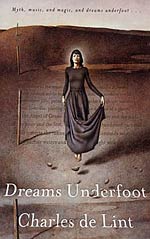
Charles de Lint has been on my ‘authors to read’ list for years and it feels a little silly over thirty years since the publication of ‘Dreams Underfoot’ for me to be raving about this new and exciting author I have ‘discovered’. However, I can’t escape the feeling that I have read something magical, and I have this feeling that I want to read so much more.
I’ve recently rated books lower than I liked them because of elements in how they are written could have been better. With ‘Dreams Underfoot’ I feel it’s the opposite in that the sum of the parts far outweighs the elements that could annoy me on another day. I do get some of the criticisms of this book – there does appear to be an almost white liberal saviourism of the unhoused and economically disadvantaged, an overly romantic view of the bohemian starving artist and a general loveliness (and attractiveness) to most of the characters. Some of these characters in another book or by another writer would annoy me, but de Lint gets a free pass. Why? Because the book is magical.
‘Dreams Underfoot’ is a short story collection mostly set in the fictional city of Newford in Canada (loosely based on Ottawa). It is a place in which the magical, the folkloric, the supernatural are in plain sight intersecting with the city – if only one knows how to really look. It is a city where one could live forever and never know there was anything different going on, or it is a city where ghosts, mermaids, fairies and ancient gnomes are around every corner. Parts of the city are fantastical itself as if parts are closed off due to extreme social deprivation which in the absence of law and order, a more or less collaborative autonomous way of being springs up instead.
de Lint draws on fairy tale, mythology, European folklore, indigenous wisdom and other stories to craft Newford. What he manages to do very well is neither make the city crowded with everything he can think of thrown in, now fall victim to an overarching story or rationale for why things are the way they are. They just are. A ghost can exist next to a mermaid and it’s okay.
His characters are a collection of mostly artists, mostly interrelated through friendships who are incredibly creative, often pretty scraping a living busking or painting or whatever, dressed in the grungy styles of the 90s. I can see why this may annoy folk. Maybe my own experiences in the 90’s are sympathetic to de Lint. I was a squatting punk, I knew a bunch of people living on the margins of society. I knew plenty of people who were wonderfully creative, with dreams of earning a living through poetry and juggling. I could walk through different parts of society feeling safe in areas some would dread to walk. Yes, some of this is fantastical, whimsical even but I’ve met plenty of people around that time who were very serious about magic and the fey whilst playing in a band and living in a van. I don’t look at the past through rose tinted glasses, but I feel I am quite happy for de Lint to reimagine on my behalf.
I love the structure of this collection. Whilst everything was published separately, the order of the stories unveils the city and its people in ways that make every discovery exciting, or a delight. I can think of only two stories that really wouldn’t work if read out of order but the collection works better in order. We are introduced to characters, who then crop up a few stories later as a friend of someone else. Someone is mentioned once by name, and then again and again, but we only hear their story right at the end. As the collection develops, we have this rich tapestry of a handful of core characters who serve as a basis for the rest of the characters in the collection to weave around. It’s a really nice way of making Newford feel alive, to create a sense of connection and community without making the collection feel like the story of a small group of people. The magic feels organic, alive.
If there is a heart of the book it is the character Jilly Coppercorn, an artist who seems to know everyone and although she has stories of her own, she is almost like connecting glue to others. We’re led in almost a very gentle way, a rather twee and whimsy fashion to see her as a pixie-like wanderer, spreading good vibes and a smile where ever she goes. It’s probably about two thirds of the book when we get to ‘In the House of my Enemy’ which explores Jilly’s story and it is devastating, harrowing. I read it late at night before bed and I went to sleep feeling desolate.
This sense of emotion I felt was built in part because many of the stories are at least a little bit hopeful, even if they don’t have a happy ending. There is a lightness to the prose that makes one feel a sense of wonder in the everyday. That means when things hit hard, they really do. Whether it is the loss of a loved one, death and tragedy or the threat of sexual predators (two of the stories involve themes of CSE and reader caution is advised).
Much of de Lint’s stories are of transition, of a warning or observation of change and its consequences. His stories, pitched against the fantastical, like most fairy stories are about what it is to be human and our insecurities or worries. Loss and hope mesh together naturally.
I am left with a sense that maybe Jilly and her friends see all this stuff around them, not because magic is everywhere, but because they are fey themselves, they just don’t know it. Their creativity, quirkiness, and yes, assumed attractiveness creates an image of the free-spirited living among us and when I think of my youth, maybe there are quite a few people who I could say, ‘yeah they’ve got fey blood in them’. That doesn’t mean that they are not susceptible to all the human trials and concerns all of us are, but maybe, these authors, wizards, musicians and fortune tellers have not forgotten to see.
It’s hard to pick favourites in this collection but some have stayed with me longer than others. I think it’s fair to say that some were better than others, or had different tones. I am however reluctant to handpick the better ones, because for them to stand out the collection needs to be understood as a whole to get the full appreciation in my view (even if there are only two original stories in here).
I’m thirty years to late but I look forward to reading more of de Lint.